How to follow up with students who stop coming to youth group
Notice early, reach out personally, and make coming back easy. In practice that means checking your attendance every week for students who've missed two meetings in a row, having the leader who knows them best send a short, no-pressure message within a few days, and inviting them back to something low-key. This guide walks through each step, with message examples you can adapt.
Why the first two missed weeks matter most
Students rarely announce they're leaving youth group. A sports season starts, a friend stops coming, a Wednesday gets busy, and one missed week turns into six. By the time anyone notices, the habit is gone and coming back feels awkward.
The longer the gap, the harder the conversation. A text after two weeks reads as "we noticed you weren't there." A text after two months can read as "why haven't you been coming?" Youth ministry writers make the same point: leaders often assume a student who has been gone a while is done, when many would come back if someone noticed and reached out sincerely (Download Youth Ministry).
A good rule of thumb: two missed meetings in a row is the time to reach out. That's early enough to feel caring rather than awkward, and late enough that you're not messaging every student who had a dentist appointment.
Step 1: Know who's missing (10 minutes a week)
You can't follow up with students you haven't noticed are gone. For a group under about 15, you might just know. Above that, faces blur, especially when a student only came for a semester. You need a record.
- Take attendance every meeting, the same way. A sign-in sheet, a spreadsheet or a check-in app all work, as long as it happens every week. Gaps in the record make everyone look like they've stopped coming.
- Pick a set time to review it. Thursday morning after a Wednesday night works well: the week is fresh and there's time to reach out before the weekend.
- Make three short lists: students who've missed two meetings in a row, students who've missed four or more, and first-time visitors from this week. The last group matters too. The second visit is when new students either stick or disappear.
If you use a spreadsheet, our free church attendance template works out "weeks missed in a row" for you and turns two or more orange.
Step 2: Decide who reaches out
The best person is usually not the youth pastor. It's the adult leader the student knows best: their small group leader, the volunteer who drives them home, the leader they talk to at the snack table. A student who might ignore a message from "the youth pastor" will often answer someone they already have a relationship with.
- Split the list by small group or grade so every name has one owner. Shared lists mean everyone assumes someone else sent the text.
- Ask leaders to report back with one word: replied, no reply, or needs the pastor. That's enough to spot the students who need more than a text.
- Peers can help, but they don't replace adults. A friend's "you coming Wednesday?" is powerful. Encourage it, but keep the adult follow-up in place too.
Step 3: What to say
Keep the first message short, warm and pressure-free. You're reopening a conversation, not asking for an explanation. A few examples to adapt into your own voice:
- "Hey Jordan, we missed you at youth the last couple of weeks! Hope school's going OK. No pressure, just wanted you to know we noticed."
- "Maya! It's been a while. How did the volleyball tournament go? Would love to hear about it sometime."
- "Hey Sam, we're doing pizza and the big game night this Wednesday. Would be great to see you if you're free."
What to avoid:
- Guilt. "We haven't seen you in ages" lands as an accusation, however kindly it's meant.
- Interrogation. "Is everything OK? Why haven't you been coming?" puts a 14-year-old on the spot.
- Group shaming. Never post absences or "we miss you" shout-outs in the group chat.
If they reply, listen first. Ask about their schedule, their season, what's been going on. Sports, jobs, family changes, school stress and friendship shifts explain most absences, and knowing which one tells you what kind of invitation makes sense next.
Step 4: Make coming back easy
Walking back into a room after a month away takes courage, especially for a younger student. Lower the bar:
- Invite them to something low-stakes first: a game night, a service project, helping set up, a snack run before group. Something where showing up doesn't mean sitting through a talk wondering if everyone noticed they were gone.
- Pair them with a friend who's still coming, or let them know who'll be at the door.
- Make the welcome normal. A greeting is great. A spotlight isn't. "Hey, good to see you" beats announcing their return.
- Work around real conflicts. If they're in a fall sport, they may be back in winter. Say so: "Totally get it. We'll be here when the season's over."
Step 5: Keep the door open for the long haul
Not every student comes back, and that's not a failure of follow-up. The goal is that every student knows someone noticed and the door is open. Some practical limits:
- Two or three messages, then ease off. After that, check in at natural moments: a birthday, a big event, the start of a new semester.
- Involve parents thoughtfully. For middle schoolers especially, a friendly note to a parent is often more effective than texting the student, and it keeps communication transparent.
- Watch for students who need more than a text. A student who's withdrawing from everything, not just youth group, may need a pastor or a parent to know.
- Follow your church's child-safety policy. Many churches have rules about how adult leaders message minors, such as including a parent or a second leader, or using group messages. Follow-up is only helpful if it happens within those guardrails.
A weekly follow-up checklist
- Take attendance at every meeting, including new students' names and a parent contact.
- The day after group, list students who've missed two in a row, four or more, and this week's first-timers.
- Assign each name to the leader who knows them best.
- Leaders send a short, warm message within a few days.
- Leaders report back: replied, no reply, or needs the pastor.
- Invite returning students to something low-key, and welcome them normally.
- Ease off after two or three messages, and check in at natural moments.
Where RollCall fits
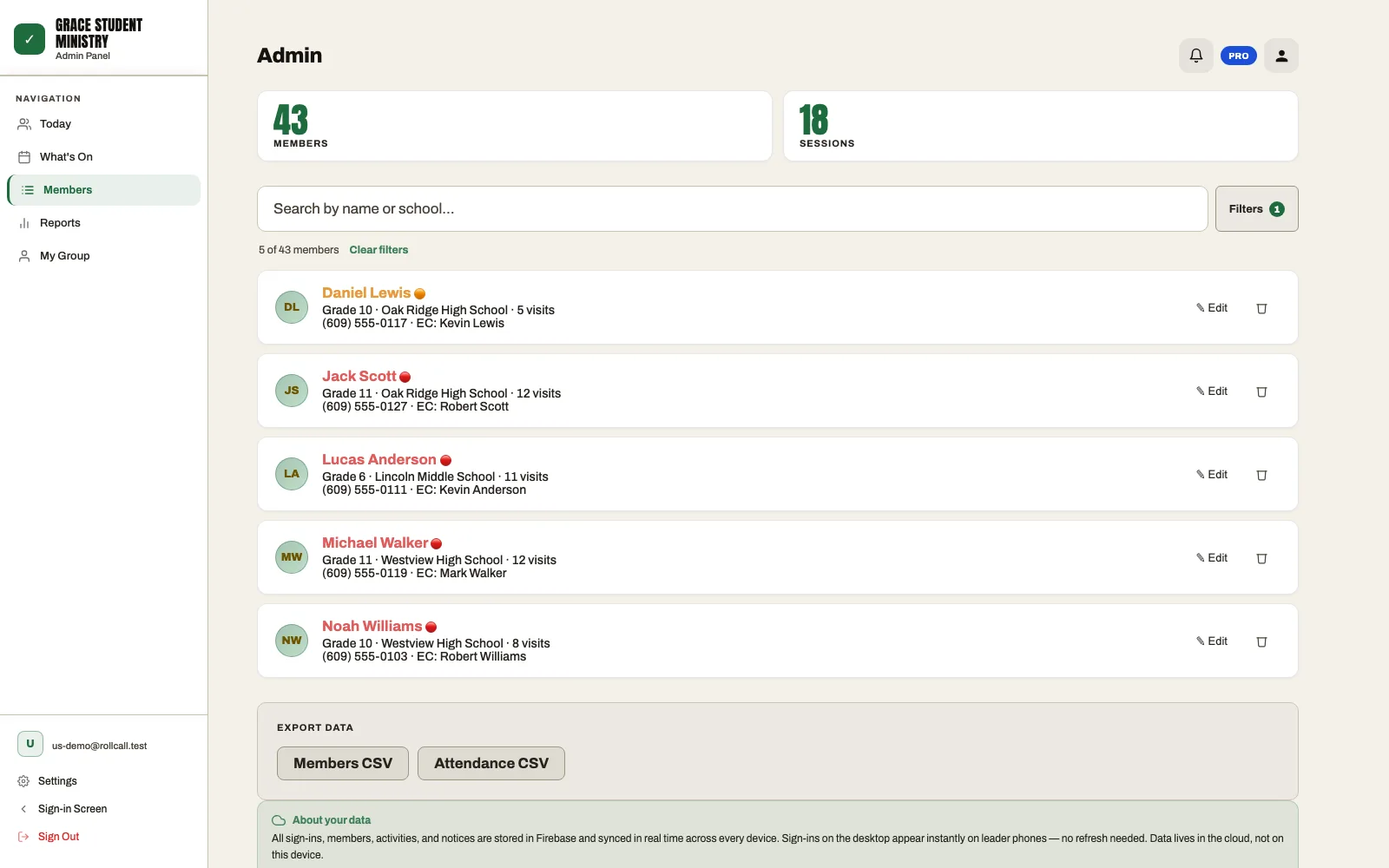
The hardest part of this routine is Step 1: noticing, consistently, every week. That's the part RollCall automates. Students check themselves in on a tablet or their own phone as they arrive. Each profile shows how many sessions they've attended and when they were last there. The Members list filters to Missed 2+ or Missed 4+ weeks in a row, and session history lists each night's first-timers.
Each small group leader can sign in with a PIN and see a Missed 2+ Weeks list for just their students, with a Text button that opens their own phone's messaging app. RollCall doesn't send anything automatically. The message still comes from a person who knows the student, which is the point.
Common questions
How many missed weeks before I should follow up?
Two meetings in a row is a good trigger for a first, friendly message. It's early enough that the habit hasn't broken and the message feels natural. Four or more missed meetings usually deserves a more personal conversation, and possibly a note to a parent.
Should the youth pastor or a volunteer reach out?
Usually the adult leader the student knows best, often their small group leader. Students are more likely to reply to someone they already have a relationship with. The youth pastor can step in for students who don't respond or who seem to be struggling more broadly.
Is it OK to text students directly?
Follow your church's child-safety policy. Many churches allow messages from approved leaders but ask that a parent or a second leader is included, or that leaders use group messages. If you're unsure, contacting the parent is always appropriate.
How do I keep track of who's missing without a lot of admin?
Take attendance the same way every meeting, then spend ten minutes the next day listing students who've missed two or more in a row. A spreadsheet with a "weeks missed in a row" column works for small groups; check-in software like RollCall can show the list automatically.
What if a student says they're not coming back?
Thank them for letting you know, tell them they're always welcome, and respect it. Check in at natural moments like a birthday or a big event, but don't keep pushing.
Want to see how this could work for your group? You can try RollCall free. It's free for groups of up to 30 members, with no card needed. Or see how RollCall works for churches.